Saturday, August 16, 2014

Where they meet: Economic Models and displacement

I <3 Economics is the Professor, John B. Taylor's opening line and end goal for his students. Oddly enough I am intrigued! This course is challenging but accessible, so if you are considering taking an online course, I say give it a try. One of the things about this class is that we have reading and prompts to help us apply the concepts, the last prompt made me realize I have real opinions about the shifts in my hometown.

Prompt: This article is an opinion piece on rent control in San Francisco. If rent control is economically inefficient, why is it still used as a public policy tool? What might some consequences of rent control that may hurt those that they are trying to help?

My Reponse (slightly in response to a peer's comment about her honest and compassionate father-in-law who owns a building of apartments in SF):
I see your point, but at the same time...U.S policy deals with the hard decisions between support of its constituents and the “free market.”  Something that I am learning is that Economics is about numeric or theoretical efficiency based on patterns of behavior. With that said there are times that the economically efficient response is not the compassionate response. It seems that we could develop possibly different housing markets all together to take into account the variety of demand and supply numbers we know are at play when we discuss people’s income and their ability or inability to find affordable and quality housing. Often this also means that if you are in a cheaper location for housing, you have a higher transportation/commute time which is not a reasonable economic outcome for specifically low-income workers.

To go back to the question, how can these policies hurt the people they are tying to protect; let’s look at SF now. Even though I grew up there I probably will never be able to live there again. Due in part to the Ellis Act and that rent control property owners are opting to find loopholes to kick everyone out QUICKLY to build condos and houses for even more wealthy people; can't we see this viscious cycle of greed by now? This leaves thousands of families having to quickly find new, affordable places that are miles away from their jobs and communities.

I am curious to learn if anyone knows of more equity based and efficient housing markets. I like the idea of employee housing programs, but those programs have failed us in the past. I see that policy can be more flexible and nimble and that we do have to curtail the higher ups from being so damn greedy.

I understand the story of your honest father-in-law, but there is also the story of thousands of people being displaced just because a place has been perceived as trendy when it was ALWAYS dynamic, compelling, eclectic, and now it's palatable by our "higher educated" populations that cannot create their own dynamic environments where they stand.

My slogan and goal moving forward:
I <3 equity

Please leave comments and resources below, as this is a new trajectory and line of inquiry for me. I hope to investigate this full time soon and to hear many more critical opinions and cases.

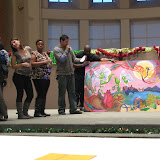
Images: the summer Internship I facilitated investigating the multiple perspectives to gentrification in the Mission. http://inclinegallerysf.com/2014/08/06/youth-art-exchange-mission-shift/

Sunday, August 4, 2013

Brooklyn Museum: LaToya Ruby Frazier: A Haunted Capital

A personal story explored in public, with that as the intention. I also appreciate that LaToya is still working in analog photography!

http://www.brooklynmuseum.org/exhibitions/latoya_ruby_frazier/#

Saturday, August 3, 2013

multi tasking-artist style

Experimenting with markers, portable and tradeable art forms-STICKERS! Looking at my reflections on home, public housing, SF/Oakland, urban space and the politics of space-built and natural. Any feedback or ideas would be greatly appreciated. Visit album here: https://plus.google.com/u/0/105226358507966151740/posts/6vv8JHnmRkz


Tuesday, December 6, 2011

Will Power-Engergizing Keynote in MA 2011

Please follow this link to hear the amazing performer and educator Will Power, as he addresses the crowd at the 2011 Conference for Community Arts Education in MA.
Video HERE

Wednesday, November 30, 2011

Getting Paid as a Freelancer

Below is a great resource for independent workers who are starting from scratch in terms of creating Contracts and finishing project negotiations.

The Art of Negotiation

Tuesday, November 22, 2011

2010 Grant Presentation

Check out my 2010 Center Student Grant Project that was one of the starting elements in my investigation in the public housing institution.
Youtube link: http://youtu.be/Ds2EkFuBS64

Friday, October 7, 2011

The debate of the Business: Non-Profit Business Growth Potential

Trying to understand who voice is the voice of the sector can be difficult-But I admire that we have a healthy conversation of people in the field and those looking from the outside in. Here are some snippets of the dialogue...

A) The Emerging Capital Market for Nonprofits
by Robert S. Kaplan and Allen S. Grossman   October 2010


Fifty years ago, Microsoft, Wal-Mart, Intel, Apple, Cisco, Oracle, and Google didn’t even exist. Today each one has a market value exceeding $100 billion. Meanwhile, many companies that were business giants in 1960—including Bethlehem Steel, U.S. Steel, CBS, RCA, GTE, ITT, and LTV—have disappeared, shrunk, or merged into other companies. These dramatic shifts in fortune are vivid examples of the cycle of creative destruction famously described by the economist Joseph Schumpeter.

Few new nonprofit ventures, in contrast, ever reach national scale (Habitat for Humanity and Teach for America are among the exceptions), and the largest nonprofits rarely fall out of the top rankings or disappear. Apparently, Schumpeter’s cycle doesn’t operate in the social sector.

That few innovative nonprofits grow to a significant size is, at first, surprising, since each year people make massive new investments in this sector. In both 2007 and 2008, donations to nonprofits in the United States exceeded $300 billion—more than 2% of GDP. But small local organizations dominate the sector. More than 700,000 nonprofits operated in the United States in 2009. Ninety percent of them had annual budgets of less than $500,000, and 99% spent less than $10 million on their constituents. The average grant size for large foundations was only $50,000. (Cont. HERE)


B) Creative Destruction, Oversimplification, and Assessing Philanthropy 

by Phil Buchanan, October 14th, 2010

Here comes another piece that oversimplifies the nonprofit sector and sees improving it as a matter of simply importing the “dynamics” of for-profits.  This one, by Harvard Business School’s Robert S. Kaplan and Allen S. Grossman, is yet another in a long list of examples of this kind of thinking, which I have written about over the past two years (including here, here, and here).

Kaplan and Grossman open with a lament that the nonprofit sector lacks the “cycle of creative destruction famously described by the economist Joseph Schumpeter.”

Right!  That’s precisely the point.

Nonprofits take on issues that other actors in our society cannot or will not — the challenges markets haven’t solved. If market forces could solve everything, we would not need a nonprofit sector.
As Bill and Melinda Gates point out frequently (including on this recent 60 Minutes segment), if we left if to the markets to decide what diseases to do research on, we would pay attention only to the diseases affecting those with an ability to pay (even more so than we already do). Kaplan and Grossman seem not to understand — or perhaps choose not to acknowledge — that the ability to operate outside of traditional market dynamics is at the root of why the nonprofit sector matters!...(Cont. HERE)


Revitalizing Struggling American Cities (September 16, 2011) | Stanford Social Innovation Review

Revitalizing Struggling American Cities (September 16, 2011) | Stanford Social Innovation Review

Thursday, September 1, 2011

The Art of Asking Questions - Ron Ashkenas - Harvard Business Review

The Art of Asking Questions - Ron Ashkenas - Harvard Business Review

I often find myself going back and forth trying to compile information I need to complete/start a project. This was a nice and direct article on the topic of setting yourself straight by asking effective questions.

Friday, July 29, 2011

Interesting Research-Almost Same Old Same Old...But Relateable

Wednesday, July 13, 2011

Freelance Resources

I have personally been seeking opportunities to learn more ways to better manage my personal and professional practices, as a independent contractor and freelance designer it is hard to show the value of ones work. I found this website that helps freelancers calculate bill rates for work/contracts. Hope this helps out, I know it will make my life easier.


Another Financial and Professional Resource:

Resource Link


Thursday, June 23, 2011

Network After Work at Public Works

Network After Work at Public Works

Connecting a multitude of industries...Hopefully I'll be able to attend. Please check it out.

Sunday, June 19, 2011

Event Photography


Click on the photo to see more of my event photography.
Thank You!

Sunday, June 12, 2011

Looking for a new Team Member??

Ok So this is typical, but I am looking for employment right now-Post BFA from CA College of the Arts. I am uploading my resume in this blog and also below are some photographs of my multiple fields of work.

I also do freelance: photography (event, professional, art, and product), event planning, fund development, and graphic design (print production).

If you have leads please contact me:)

MERCI!!

Tuesday, May 10, 2011

Dis/Assembling Public Housing_pt 1

In April 2011, I display the work that I have been collecting and investigating for the past year and a half. I often came upon questions instead of answer to my initial proposal, but now I know that questions are the way to start a conversation on what public housing is and who are the people involved; after my thesis show at CCA, I am now more interested in how people are involved and the power that individuals have within this institution.
Check out some photographs of the process